
What to Do If You Get Hurt Skating Abroad
From road rash to a real hospital visit: what to sort out before you travel, how to handle minor injuries yourself, and the red flags that mean you need actual care — sourced from NHS, EU, and government travel guidance.
Este artigo está disponível apenas em inglês por enquanto.
Intro
Most injuries on a skate trip aren't the sjukhus-level kind — they're road rash, a rolled ankle, a hard bail that leaves you sore for a week. But knowing the difference between "walk it off" and "get this checked" — and being prepared before you leave — makes the difference between a bad afternoon and a genuinely ruined trip. This guide covers both: what to sort out before you fly, and how to handle everything from scraped palms to an actual hospital visit.
Before you travel
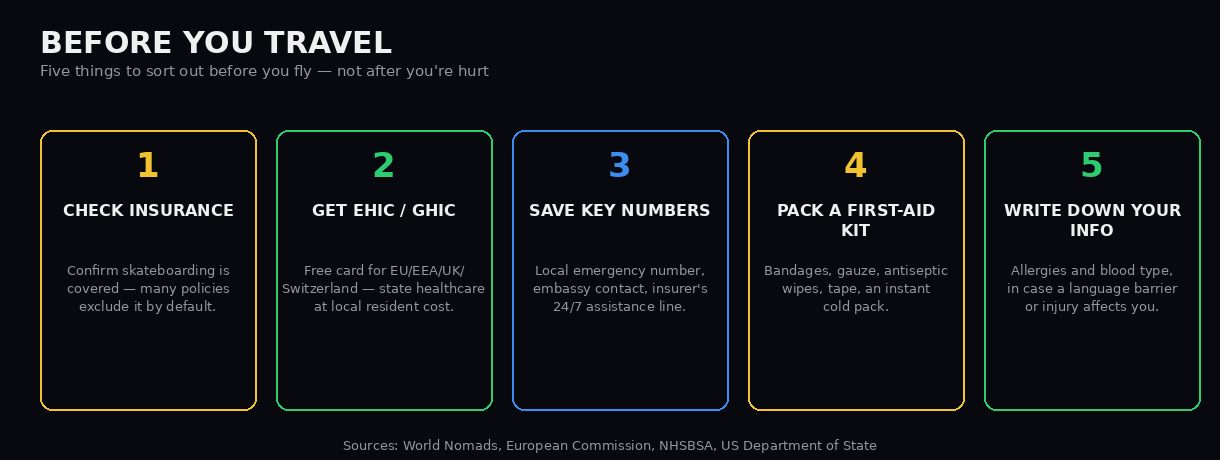
Check whether your travel insurance actually covers skateboarding — many don't by default. Skateboarding, especially ramp/park/vert riding, is commonly classified as a "hazardous" or "adventure" activity requiring specific declaration. World Nomads, a major travel insurer, lists "Skateboarding (ramp, half pipe, skate park, street)" as its own named category in their activity-coverage list — meaning it needs to be explicitly selected, not assumed to be included under a standard policy. Source: worldnomads.com — Cover for Activities, Sports and Experiences
If you're in the EU/EEA/UK/Switzerland, get an EHIC or GHIC card before you go — it's free. It gives you access to state-provided healthcare at the same cost as a local resident during a temporary stay. Important limits: it does not replace travel insurance, doesn't cover private clinics, and doesn't cover repatriation home. Source: European Commission — European Health Insurance Card; NHSBSA
Know what your embassy can and can't do for you. If you're seriously injured abroad, your embassy/consulate can help locate medical services and notify family — but they will not pay your medical bills. The US State Department states this directly: "a consular officer can assist in locating appropriate medical services... However, payment of hospital and other expenses is the responsibility of the traveler." This is a common misconception worth clearing up before you need it. Source: US Department of State (travel.state.gov / exchanges.state.gov)
Practical prep checklist:
- Save your destination's emergency number (it's not always 911/112 — check before you go)
- Save your embassy/consulate contact info and your insurer's 24/7 emergency line
- Carry a basic first-aid kit: adhesive bandages, gauze, antiseptic wipes, tape, an instant cold pack
- Know your own allergies/blood type and carry them written down (useful if a language barrier or head injury affects your ability to communicate)
Part 1: Minor injuries you can usually handle yourself
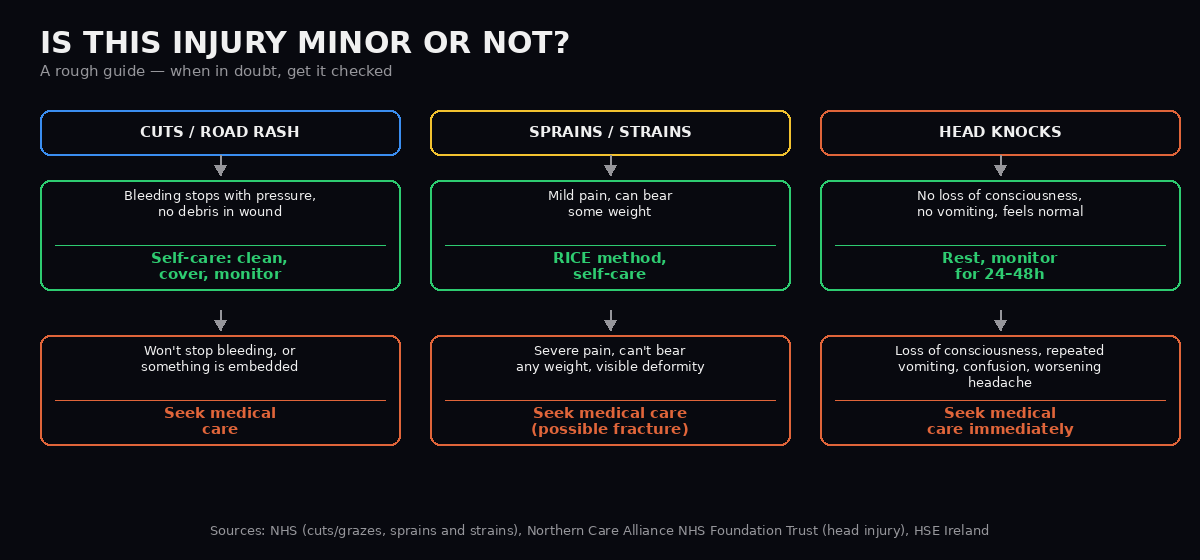
Cuts and road rash. According to the NHS, most cuts and grazes can be treated at home: stop any bleeding with direct pressure, clean the wound under running water, and cover it with a clean dressing. See a doctor if there's a risk of infection — for example if the wound was contaminated with dirt, or if something is stuck in it (don't try to remove embedded objects yourself). Source: NHS — Cuts and grazes
Sprains and rolled ankles/wrists — the RICE method, explained properly:
RICE stands for Rest, Ice, Compression, Elevation — the standard first-response approach for sprains, strains, and bruises, used in the first 24–72 hours after injury.
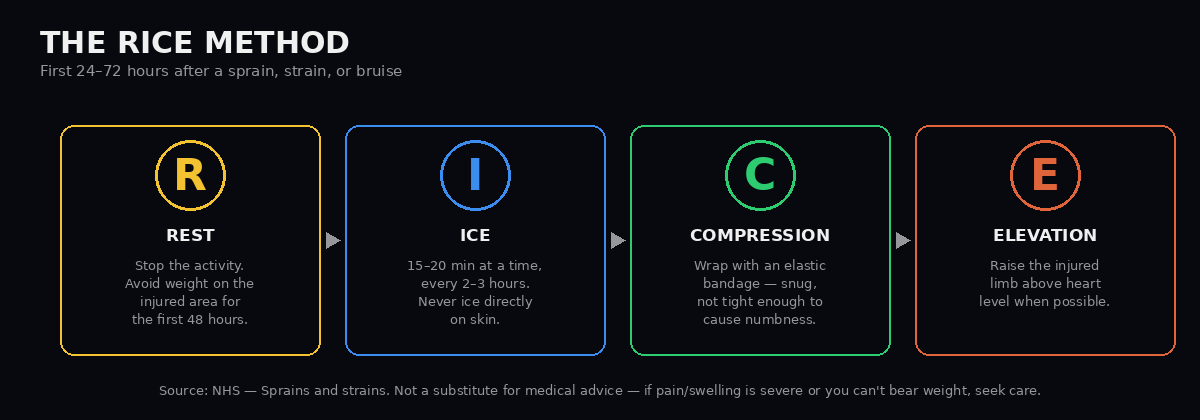
- Rest — Stop the activity immediately and avoid putting weight on the injured area. This isn't about staying still for days; it means protecting the joint for the first 48 hours before gradually reintroducing movement. Continuing to skate on a rolled ankle risks turning a mild sprain into a much worse one.
- Ice — Apply an ice pack (or a bag of frozen vegetables wrapped in a towel — never ice directly on skin) for 15–20 minutes at a time, every 2–3 hours. This helps numb pain and limit swelling, especially in the first two days.
- Compression — Wrap the area with an elastic bandage, snug but not so tight it cuts off circulation (numbness or tingling means it's too tight). This helps control swelling.
- Elevation — Keep the injured limb raised above heart level when possible, which also helps reduce swelling.
Source: NHS — Sprains and strains
One honest caveat worth including: RICE has been the standard advice since 1978, but more recent sports medicine research has questioned parts of it — particularly whether ice actually speeds healing (it may just numb pain), and whether prolonged complete rest can delay recovery by causing stiffness. Current guidance leans toward protecting the injury rather than fully immobilizing it, with a gradual, pain-guided return to movement rather than waiting until it feels 100%. RICE is still a reasonable first response — just not a guarantee of faster healing on its own. Sources: Cleveland Clinic; Yale Medicine
When RICE isn't enough — see a doctor if: pain or swelling is severe, you can't bear any weight at all, or things aren't improving after a few days of self-care. RICE can make an injury more comfortable, but it can't tell you whether it's a sprain or an actual fracture.
Part 2: When it's not minor — red flags that mean seek care
Head injuries / possible concussion. Most head knocks are not emergencies, but seek medical care immediately if you notice:
- Loss of consciousness, even briefly
- Repeated vomiting
- Worsening headache not relieved by pain medication
- Confusion, slurred speech, or unequal pupil sizes
- Symptoms that appear or worsen in the 24–48 hours after the fall
Sources: NHS-affiliated Northern Care Alliance head injury advice; HSE Ireland
Other clear signs to get checked rather than self-treat:
- A wound that won't stop bleeding with direct pressure after several minutes
- Visible deformity, or inability to bear any weight — possible fracture
- A wound with something embedded in it
- Any doubt at all about a head injury — err toward getting checked
Part 3: If you end up at a hospital abroad
Know that many countries expect payment upfront, even in emergencies. This varies hugely by country — some public systems (with EHIC/GHIC coverage in Europe) charge little or nothing at the point of care; others, including the US and many private facilities worldwide, expect payment or insurance verification before or shortly after treatment. This is exactly why the insurance step above matters — check what your policy actually requires (pay-then-claim vs. direct billing).
What to bring/have ready:
- Passport or ID
- Travel insurance policy number and 24/7 assistance line
- EHIC/GHIC if applicable
- A note of any allergies, medications, or existing conditions
What your embassy will actually do: help you find an English-speaking doctor or appropriate facility, contact family on your behalf if needed, and in serious cases help coordinate next steps — but again, not pay your bill. Source: US Department of State; UK FCDO consular assistance guidance
Checklist
- Confirm your travel insurance explicitly covers skateboarding — check the activity list, don't assume.
- If traveling in Europe: apply for a free EHIC/GHIC before you go.
- Save your destination's local emergency number, your embassy's number, and your insurer's assistance line.
- Pack a basic first-aid kit.
- Know the RICE method for sprains and basic cut/graze care.
- Know the concussion red flags — don't self-diagnose a head injury.
- Understand your embassy helps coordinate care, not pay for it.
Sources
- NHS — Cuts and grazes: nhs.uk/conditions/cuts-and-grazes/
- NHS Inform — Cuts and grazes: nhsinform.scot
- NHS — Sprains and strains
- Cleveland Clinic — Should You Still Use the RICE Method for an Injury?
- Yale Medicine — Is There a Better Way to Use RICE for Your Injury?
- Northern Care Alliance NHS Foundation Trust — Head Injury Advice
- HSE Ireland — Head injury and concussion
- European Commission — European Health Insurance Card (EHIC)
- NHSBSA — Where you can use your EHIC/GHIC card
- World Nomads — Cover for Activities, Sports and Experiences
- US Department of State — Medical Care abroad (travel.state.gov / exchanges.state.gov)
- UK Foreign, Commonwealth & Development Office — Emergency help for British nationals (gov.uk)