
Flying With a Surfboard: What You Actually Need to Know
Length limits, oversize fees, liability and fin rules for more than fifty airlines, checked against their own pages — plus how to pack a board so it arrives in one piece.
Este artigo está disponível apenas em inglês por enquanto.
Intro
A surfboard is the awkward cousin of the skateboard: it's too long for any cabin, it's fragile in exactly the places baggage handlers are rough on, and airlines can't agree on whether it's sports equipment, oversize luggage or something they'd rather not carry at all. The good news is that nearly every major airline will take one. The bad news is that the rules, fees and liability terms differ a lot, and some airlines don't mention surfboards on their official pages at all.
This guide follows the same approach as our skateboard article: every airline rule below is taken from the airline's own wording and linked at the bottom — more than fifty airlines across four regions, with the ones we could not read marked as such. Where we couldn't read an official page — several airline sites block automated readers or hide their fee tables behind JavaScript — we say "not verified" rather than guess. Policies change often, so everything here was checked in October 2026 and should be confirmed with your airline before you book.
Quick overview
A surfboard never goes in the cabin. The four tables below cover the airlines we checked, region by region, with the detail and the gaps in Part 1. The real questions are whether your airline accepts it, how it's priced, and whether it counts inside your normal baggage allowance or as a separate oversize item.
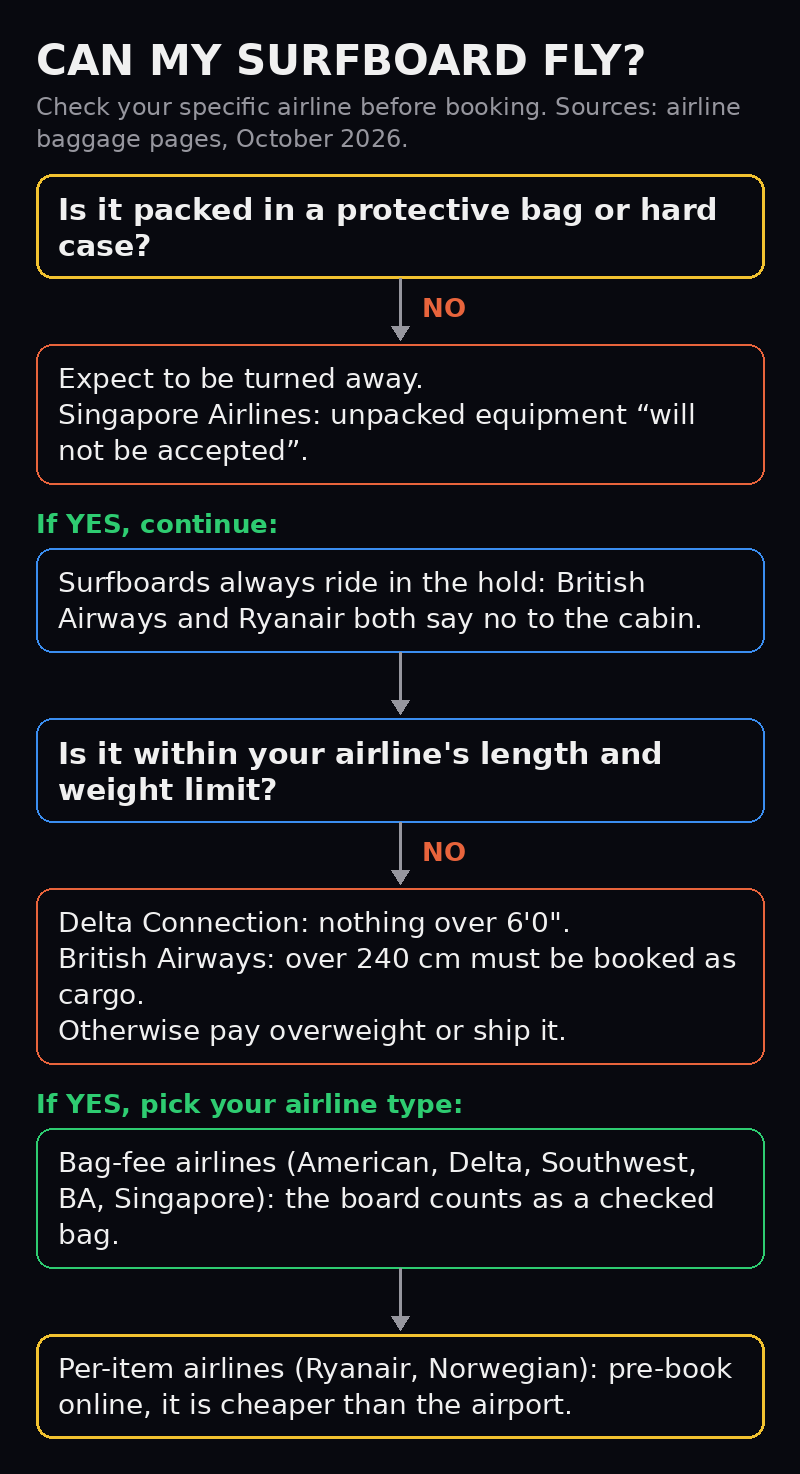
The short version: best and worst deals
Prices cannot be compared like for like across fifty airlines, because most airlines publish a rule rather than a price, and some publish neither. So the ranking below uses only what each airline's own page states. The cheapest airlines are the ones that treat a surfboard as an ordinary checked bag with no surfboard surcharge. The dearest are the ones that add a fixed fee on top, and the chart shows those fees in approximate US dollars.
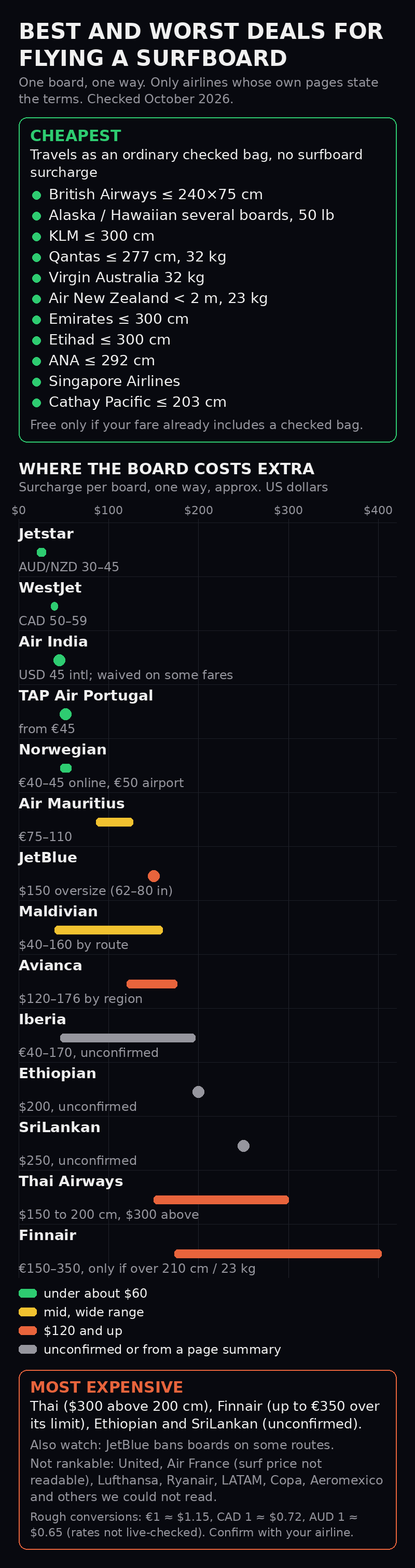
Best deals. British Airways, Alaska and Hawaiian, KLM, Qantas, Virgin Australia, Air New Zealand, Emirates, Etihad, ANA, Singapore Airlines and Cathay Pacific carry a board inside the normal checked-baggage rules with no separate surfboard fee. Alaska and Hawaiian stand out if you travel with several boards, because a single bag may hold more than one. This only holds if your fare already includes a checked bag.
Most expensive. Thai Airways charges about $150 for a board up to 200 cm and $300 above that on its own flights. Finnair's oversize fee reaches €350 on Europe–Australia, New Zealand and Fiji routes, but only if the board is over 210 cm or 23 kg. Ethiopian ($200) and SriLankan ($250) also look expensive, but both came through a page summary and we could not confirm them. JetBlue charges $150 for oversize and does not accept surfboards on some routes at all.
Cannot be ranked. United, Air France's surf-specific price, Lufthansa, Ryanair and several Latin American airlines state no price we could read. Ask them before you book.
Part 1: Airline policies, region by region
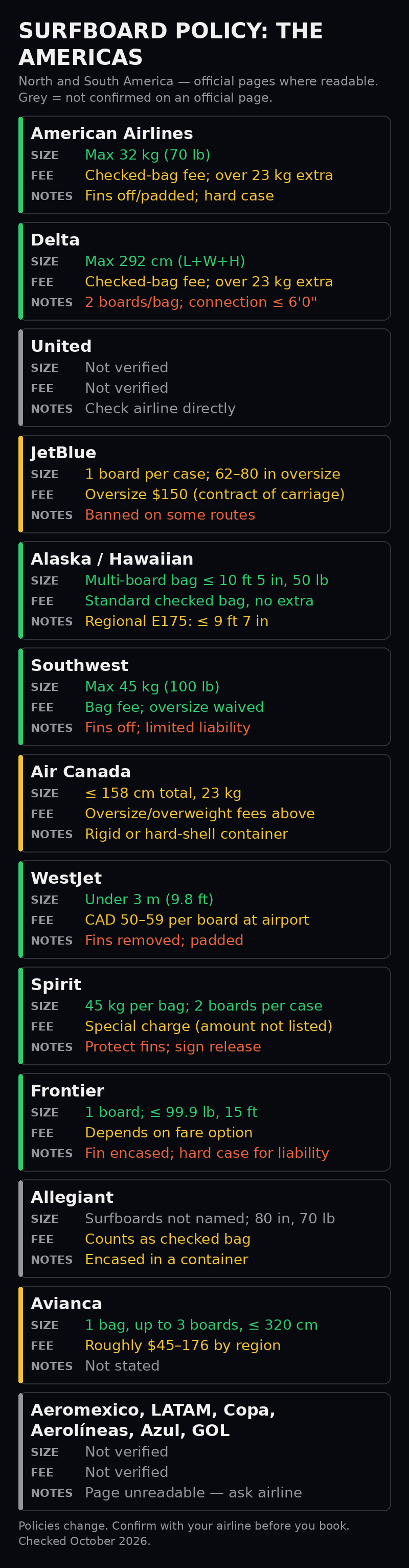
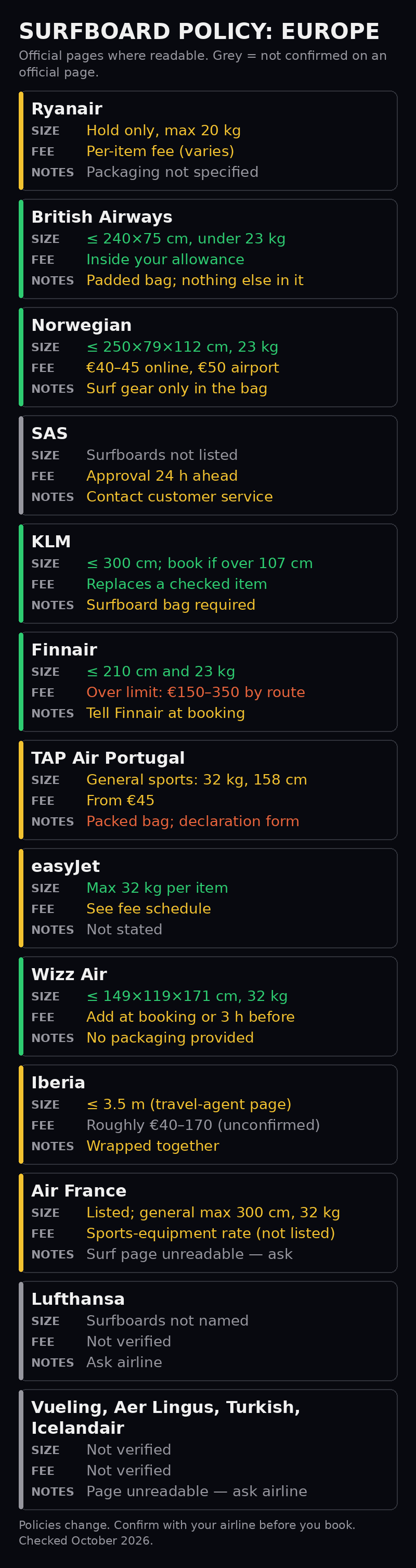
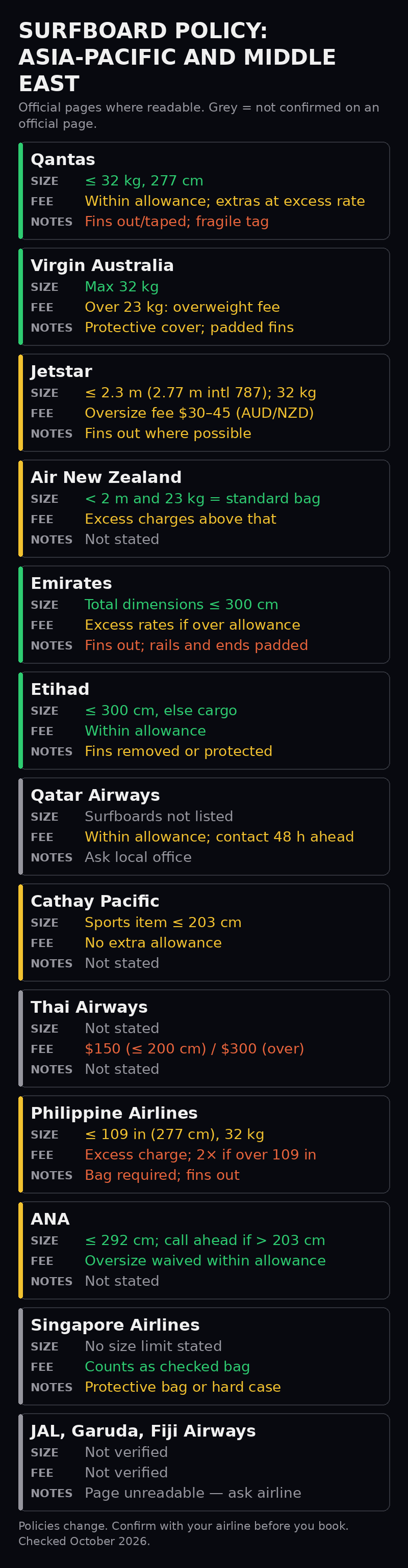
All of these are hold-luggage rules. Each table is read from the airline's own page where we could read it; "not verified" means the page failed to load or did not mention surfboards, not that the airline has no rule. Where an entry came through a page summary rather than a clean read, the notes under the table say so.
The Americas
| Airline | Size / weight | Fee | Packing and notes |
|---|---|---|---|
| American Airlines | Max 32 kg (70 lb) | Checked-bag fee; over 23 kg extra | Fins off/padded; hard case |
| Delta | Max 292 cm (L+W+H) | Checked-bag fee; over 23 kg extra | 2 boards/bag; connection ≤ 6'0" |
| United | Not verified | Not verified | Check airline directly |
| JetBlue | 1 board per case; 62–80 in oversize | Oversize $150 (contract of carriage) | Banned on some routes |
| Alaska / Hawaiian | Multi-board bag ≤ 10 ft 5 in, 50 lb | Standard checked bag, no extra | Regional E175: ≤ 9 ft 7 in |
| Southwest | Max 45 kg (100 lb) | Bag fee; oversize waived | Fins off; limited liability |
| Air Canada | ≤ 158 cm total, 23 kg | Oversize/overweight fees above | Rigid or hard-shell container |
| WestJet | Under 3 m (9.8 ft) | CAD 50–59 per board at airport | Fins removed; padded |
| Spirit | 45 kg per bag; 2 boards per case | Special charge (amount not listed) | Protect fins; sign release |
| Frontier | 1 board; ≤ 99.9 lb, 15 ft | Depends on fare option | Fin encased; hard case for liability |
| Allegiant | Surfboards not named; 80 in, 70 lb | Counts as checked bag | Encased in a container |
| Avianca | 1 bag, up to 3 boards, ≤ 320 cm | Roughly $45–176 by region | Not stated |
| Aeromexico, LATAM, Copa, Aerolíneas, Azul, GOL | Not verified | Not verified | Page unreadable — ask airline |
What stands out. JetBlue is the only airline whose own contract of carriage bans surfboards on certain routes (Bermuda, Santo Domingo, Santiago in the Dominican Republic, Haiti, Peru and Trinidad and Tobago), so check the destination, not just the airline. Alaska and Hawaiian announced a shared surfboard policy in November 2025 that lets you check several boards in one bag up to 10 ft 5 in and 50 lb at the standard checked-bag price; this comes from Alaska's press release, because Hawaiian's own policy page did not load. WestJet is one of the few airlines that requires fins to be removed outright. Spirit and Frontier both tie liability to how you pack: Spirit asks you to sign a release, and Frontier says it is not liable for damage unless the board is in a hard-sided case. Allegiant does not name surfboards at all and treats them as sporting equipment under its general checked-bag rules.
Gaps. United's sports-equipment page could not be retrieved, and neither could the pages for Aeromexico, LATAM, Copa, Aerolíneas Argentinas and Azul. GOL lists an "aquatic equipment" category without showing which items it covers. We publish no figures for any of these.
Europe
| Airline | Size / weight | Fee | Packing and notes |
|---|---|---|---|
| Ryanair | Hold only, max 20 kg | Per-item fee (varies) | Packaging not specified |
| British Airways | ≤ 240×75 cm, under 23 kg | Inside your allowance | Padded bag; nothing else in it |
| Norwegian | ≤ 250×79×112 cm, 23 kg | €40–45 online, €50 airport | Surf gear only in the bag |
| SAS | Surfboards not listed | Approval 24 h ahead | Contact customer service |
| KLM | ≤ 300 cm; book if over 107 cm | Replaces a checked item | Surfboard bag required |
| Finnair | ≤ 210 cm and 23 kg | Over limit: €150–350 by route | Tell Finnair at booking |
| TAP Air Portugal | General sports: 32 kg, 158 cm | From €45 | Packed bag; declaration form |
| easyJet | Max 32 kg per item | See fee schedule | Not stated |
| Wizz Air | ≤ 149×119×171 cm, 32 kg | Add at booking or 3 h before | No packaging provided |
| Iberia | ≤ 3.5 m (travel-agent page) | Roughly €40–170 (unconfirmed) | Wrapped together |
| Air France | Listed; general max 300 cm, 32 kg | Sports-equipment rate (not listed) | Surf page unreadable — ask |
| Lufthansa | Surfboards not named | Not verified | Ask airline |
| Vueling, Aer Lingus, Turkish, Icelandair | Not verified | Not verified | Page unreadable — ask airline |
What stands out. KLM treats a surfboard as one of your checked items and needs a reservation for any bag longer than 107 cm; it also says an extra fee may apply on flights to or from Canada, Mexico and the United States. Finnair is the clearest on price: a board up to 210 cm and 23 kg is one piece of special baggage priced like an extra checked bag, and above that the airport fee is €150 within Europe, and, from a single fetch of the page, €300 to or from Asia, North America and the Middle East and €350 between Europe and Australia, New Zealand or Fiji. TAP requires a Declaration of Transport for surf equipment and may refuse a badly packed board; the 32 kg and 158 cm figures on its page are for sports equipment in general, not surfboards specifically. Wizz Air's surf-equipment limit is the most generous in the table, but the airline says it cannot provide packaging.
Gaps. Air France lists "Surfing" as its own category under sports equipment, but the detail page behind that link would not load in any of our readers, so we have no surfboard-specific size, weight or price. What we could read: its additional-baggage conditions state that sports equipment is excluded from the standard extra-bag option and carries "a specific rate"; its general oversize rule accepts items up to 300 cm (height + length + width) and caps overweight bags at 32 kg; and plastic bags and household stretch film are not accepted as packaging in the hold. A third-party guide (Kima Rolls) says a board under 300 cm and 23 kg travels free if it is your only checked bag; we could not confirm that on Air France's own site, so ask Air France before relying on it. Lufthansa's page describes a "Boards" category with listed lengths of 200 cm and 315 cm, but we could not tell which applies to surfboards. Iberia's consumer page failed to load, so the entry above comes from its travel-agent page and the fee range is the page summary, not a verified table. Vueling's page names a surfboard only as an example of oversize luggage, and Aer Lingus, Turkish Airlines and Icelandair could not be read.
Asia-Pacific and the Middle East
| Airline | Size / weight | Fee | Packing and notes |
|---|---|---|---|
| Qantas | ≤ 32 kg, 277 cm | Within allowance; extras at excess rate | Fins out/taped; fragile tag |
| Virgin Australia | Max 32 kg | Over 23 kg: overweight fee | Protective cover; padded fins |
| Jetstar | ≤ 2.3 m (2.77 m intl 787); 32 kg | Oversize fee $30–45 (AUD/NZD) | Fins out where possible |
| Air New Zealand | < 2 m and 23 kg = standard bag | Excess charges above that | Not stated |
| Emirates | Total dimensions ≤ 300 cm | Excess rates if over allowance | Fins out; rails and ends padded |
| Etihad | ≤ 300 cm, else cargo | Within allowance | Fins removed or protected |
| Qatar Airways | Surfboards not listed | Within allowance; contact 48 h ahead | Ask local office |
| Cathay Pacific | Sports item ≤ 203 cm | No extra allowance | Not stated |
| Thai Airways | Not stated | $150 (≤ 200 cm) / $300 (over) | Not stated |
| Philippine Airlines | ≤ 109 in (277 cm), 32 kg | Excess charge; 2× if over 109 in | Bag required; fins out |
| ANA | ≤ 292 cm; call ahead if > 203 cm | Oversize waived within allowance | Not stated |
| Singapore Airlines | No size limit stated | Counts as checked bag | Protective bag or hard case |
| JAL, Garuda, Fiji Airways | Not verified | Not verified | Page unreadable — ask airline |
What stands out. Qantas, Virgin Australia and Jetstar all carry surfboards inside normal checked-baggage rules, and all three want fins removed or protected. Jetstar's oversize handling fee is separate from the checked-bag weight, so it adds to the bill. Air New Zealand counts a board under 2 m and 23 kg as a standard bag. Emirates is unusually specific about packing: fins removed or packed in polystyrene, bubble wrap or neoprene on the nose and tail, cardboard along the rails and a properly padded bag. Thai Airways is the only airline here that states a fixed price (about $150 for a board up to 200 cm and $300 above that, on Thai-operated flights), and one board is included in the allowance only on routes to or from Australia and New Zealand. Philippine Airlines' figures come from a tariff PDF dated July 2025, so confirm it is still current. ANA waives its oversize charge for boards between 158 and 292 cm and does not accept anything longer as checked baggage.
Gaps. Qatar Airways' official pages do not list surfboards (a third-party guide says a 32 kg board bag travels free within the allowance; we could not confirm that, so ask the local office at least 48 hours ahead). Cathay Pacific lists "surfing" only in a general sports-equipment sentence. Japan Airlines, Garuda Indonesia and Fiji Airways blocked our readers.
Africa, the Indian Ocean and South Asia
| Airline | Size / weight | Fee | Packing and notes |
|---|---|---|---|
| South African Airways | Listed: under 200 cm | Excess charges if over | Not stated |
| Ethiopian Airlines | Up to 280 cm | $200 per listing | Not stated |
| Air Mauritius | ≤ 300 cm (200 cm to S. Africa) | €75–110; oversize €150 | Not stated |
| Maldivian | Surf bag 86 × 24 in; limited number | $40–160 one way by route | Not stated |
| Air India | 300 cm total, 32 kg (naming unconfirmed) | Handling fee, waived on some fares | Not stated |
| SriLankan | Windsurf board named, 32 kg | $250 per set | Not stated |
| Royal Air Maroc | Surfboards not named | Paid generic sports tiers | Ask airline |
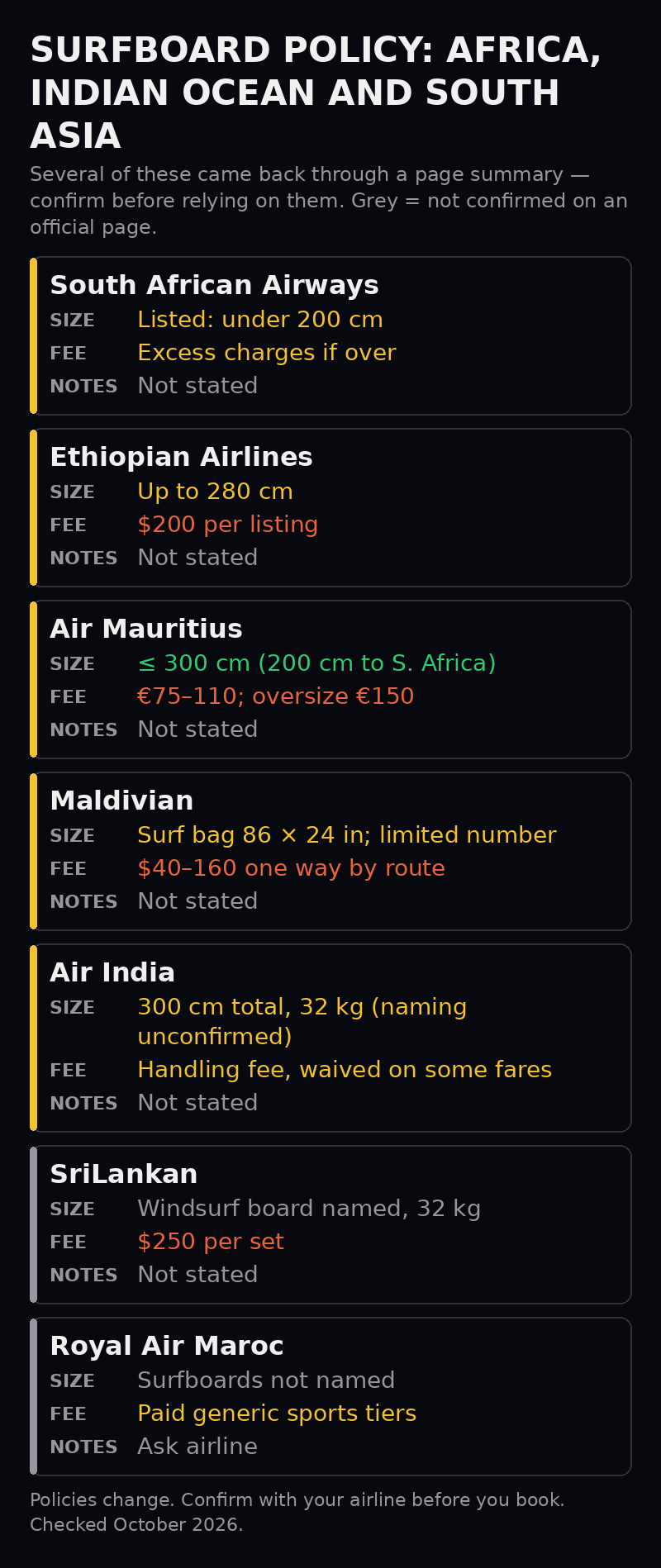
What stands out. Prices here vary widely: Air Mauritius charges €75–110 depending on the route and €150 for oversize sports equipment, and Maldivian publishes surf-bag sizes (86 × 24 in) with a cap on how many bags fit per flight and fees from $40 to $160 one way. Ethiopian lists "surf boarding equipment" at up to 280 cm and $200. These African and South Asian entries came through a page summary rather than a clean read, and Air India's page did not clearly name surfboards, so treat them as pointers and confirm the exact terms.
Gaps. SriLankan names windsurfing equipment but we could not confirm that plain surfboards are covered, and Royal Air Maroc names kitesurf gear and generic sports tiers but not surfboards.
Part 2: Packing a board so it survives
The airline rules above are sourced from the airlines. What follows is practical advice from three surf-travel guides (Ticket To Ride, Billabong and Kima Rolls), plus common sense. It's experience, not airline policy, and nothing here is guaranteed to prevent damage.
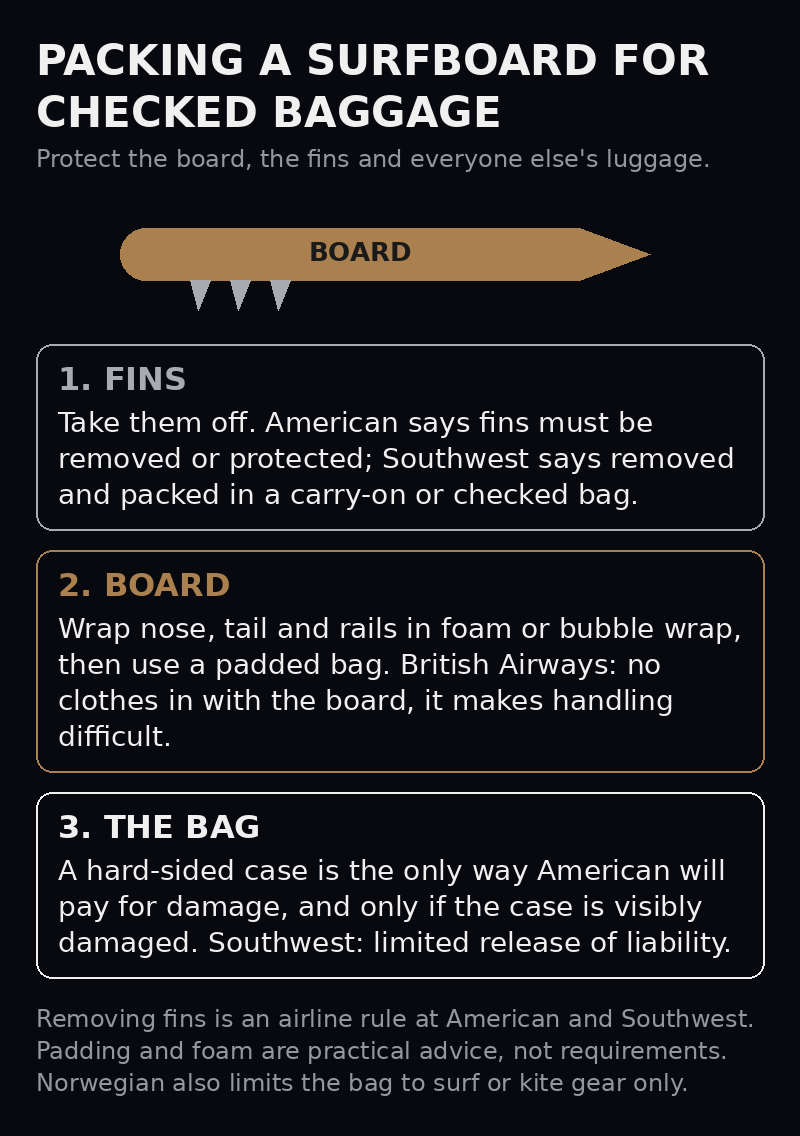
Choose the right bag. For flights, Kima Rolls recommends a travel board bag with 10–12 mm of foam padding rather than a thin surf sock. Pick a bag with removable internal dividers if you're carrying more than one board. Billabong's advice is to leave the board at least an inch or two shorter than the bag's length limit. For three or more boards, a bag with wheels is worth it. Ticket To Ride suggests a compact duo travel bag over a heavy coffin-style one where you can.
Protect the rails. Scrape off the old wax, remove the fins and keep them somewhere secure. Then wrap the rails in foam pipe insulation (cut a slit along the length) or a pool noodle, held on with masking tape. Both sources avoid duct tape, which leaves residue on the board.
Pad the deck and the ends. A layer of bubble wrap on the deck, and towels or wetsuits at the nose and tail, absorb most of the knocks. Spread soft items evenly through the bag rather than stuffing them in one place.
Use a board sock. A cloth sock around each padded board adds a last layer and stops boards scratching each other.
Fins and accessories. Keep fins, wax, a comb, leash, leash strings and a small ding repair kit together in one self-contained pouch with no sharp edges against the boards. For glass-on fins that can't be removed, wedge foam or polystyrene between them before wrapping.
Stack with care. In a multi-board bag, put the largest board on the bottom, deck side up, with smaller boards on top and all facing the same way. Use the bag's internal straps or, if it has none, spare leashes or straps to stop boards moving.
Do a shake test. Once packed, shake the bag. If anything slides, add padding. Billabong also suggests a friendly note on the bag and a polite, helpful attitude at the check-in desk.
Weigh it. Weigh the packed bag at home. An extra kilo over an airline's tier costs far more at the counter than a lighter pack costs at home.
Check the liability terms. Several airlines limit what they will pay for fragile sports equipment, and Southwest states this explicitly. Check your travel insurance covers surfboards, and photograph the board and bag before you hand them over. Put your contact details on the bag and arrive early, since oversize check-in can take longer.
A note on Australia and New Zealand
Both countries run strict biosecurity checks. Used sports equipment must be clean and declared on arrival, and a board covered in sand, mud or old wax residue can be held for cleaning. The official pages we read don't mention surfboards by name, so treat this as general guidance based on the rules for used outdoor gear: scrape off the wax and wash the board, bag and wetsuit before you fly.
A note on US security screening
We could not find a surfboard entry on the TSA's "What can I bring?" pages, so we are not stating a TSA rule for surfboards. Boards travel as checked baggage and the airline's rules above are what apply in practice.
Checklist
- Airline confirmed to carry surfboards (and contacted ahead if it's SAS or another carrier that doesn't list them)
- Bag length and board length checked against the airline's limit
- Fee confirmed, including overweight charges and any connecting flight
- Fins removed and stored in a padded pouch
- Old wax scraped off
- Rails wrapped with pipe insulation or a pool noodle
- Deck padded, board in a sock, nothing sharp touching the board
- Packed bag weighed
- Shake test done
- Insurance checked, photos taken before check-in
Sources
- American Airlines — Special items: https://www.aa.com/i18n/travel-info/baggage/special-items.jsp
- Delta Air Lines — Sports equipment baggage: https://www.delta.com/us/en/baggage/special-items
- Southwest Airlines — Special items: https://www.southwest.com/help/baggage/special-items
- Ryanair — Sports equipment: https://www.ryanair.com/gb/en/useful-info/help-centre/baggage
- British Airways — Sports equipment: https://www.britishairways.com/en-gb/information/baggage-essentials/sports-equipment
- Norwegian — Sports equipment: https://www.norwegian.com/en/travel-info/baggage/sports-equipment/
- SAS — Sports equipment: https://www.flysas.com/en/travel-info/baggage/
- Singapore Airlines — Sports equipment: https://www.singaporeair.com/en_UK/us/travel-info/baggage/sporting-equipment/
- Ticket To Ride — Top ten tips for traveling with a surfboard: https://tickettoridegroup.com/blog/top-ten-tips-for-traveling-with-a-surfboard/
- Billabong — Surfboard travel guide: https://www.billabong.com/blogs/expert-guides/surfboard-travel-mens
- Kima Rolls — Flying with a surfboard: https://kimarolls.com/en/blogs/infos/comment-voyager-en-avion-avec-une-planche-de-surf
- KLM: https://www.klm.com/information/baggage/special-baggage
- Finnair: https://www.finnair.com/en/baggage-on-finnair-flights/special-baggage
- TAP Air Portugal: https://www.flytap.com/en-us/information/baggage/sports-equipment
- easyJet: https://www.easyjet.com/en/help/baggage/sports-equipment
- Wizz Air: https://www.wizzair.com/en-gb/help-centre/booking-information-and-services/baggage/special-baggage
- Iberia (travel-agent page): https://agencias.iberia.com/content/iberia-agencias/language-masters/en/informacion-viaje/equipajes/equipajes-especiales.html
- Air France: https://wwws.airfrance.us/information/bagages/bagages-speciaux-hors-format-airfrance, https://wwws.airfrance.us/information/bagages/bagages-supplementaires-plus-grands-plus-lourds and https://wwws.airfrance.fr/information/legal/conditions-aba
- Lufthansa: https://www.lufthansa.com/us/en/sports-baggage
- Vueling: https://help.vueling.com/hc/en-gb/articles/19798811975569-Special-Luggage
- JetBlue contract of carriage (2026-06-01): https://cms.jetblue.com/public/dam/ui-assets/p/legal/Contract_of_Carriage_2026-06-01.pdf
- Alaska and Hawaiian press release (3 November 2025): https://news.alaskaair.com/guest-experience/chasing-the-next-swell-alaska-airlines-and-hawaiian-airlines-new-surfboard-policy-has-you-covered/
- Air Canada: https://www.aircanada.com/us/en/aco/home/plan/baggage/special-items.html
- WestJet: https://www.westjet.com/en-ca/baggage/sports
- Spirit: https://customersupport.spirit.com/en-us/category/article/KA-01154
- Frontier: https://www.flyfrontier.com/media/1206/baggage_fragile-and-special-items.pdf
- Allegiant: https://www.allegiantair.com/baggage-1
- Avianca: https://ayuda.avianca.com/hc/en-us/articles/13082634010139-Can-I-bring-my-sports-equipment
- Qantas: https://www.qantas.com/en-us/baggage/sporting-equipment
- Virgin Australia: https://www.virginaustralia.com/us/en/travel-info/baggage/oversized-fragile-items/
- Jetstar: https://www.jetstar.com/us/en/help/can-i-bring-my-surfboard-skis-or-snowboard and https://www.jetstar.com/us/en/help/oversized-baggage
- Air New Zealand: https://www.airnewzealand.com/oversized-items
- Qatar Airways: https://www.qatarairways.com/en/baggage/sports-baggage.html
- Emirates: https://www.emirates.com/english/help/faqs/baggage-allowances-for-sports-equipment/
- Etihad: https://www.etihad.com/en/help/baggage-information/special-equipment-and-other-items
- Cathay Pacific: https://www.cathaypacific.com/cx/en_HK/baggage/sports-equipment.html
- Philippine Airlines tariff (July 2025): https://www.philippineairlines.com/content/dam/palportal/migration/files/baggage-rules/PR_PR1_ao_01JUL25.pdf
- ANA: https://www.ana.co.jp/en/jp/guide/boarding-procedures/baggage/international/bicycle/
- Thai Airways: https://www.thaiairways.com/en-th/content/baggage/special-baggage/
- South African Airways: https://www.flysaa.com/manage-fly/baggage/checked-baggage/special-baggage
- Ethiopian Airlines: https://www.ethiopianairlines.com/us/information/baggage-information/special-baggage
- Air Mauritius: https://www.airmauritius.com/en/before-you-fly/baggage/additional-baggage
- Maldivian: https://maldivian.aero/flying-with-us/before-you-fly/high-volume-baggage-charges.html
- Air India: https://www.airindia.com/in/en/travel-information/baggage-guidelines/special-baggage.html
- SriLankan: https://www.srilankan.com/en_uk/plan-and-book/luggage
- Royal Air Maroc: https://www.royalairmaroc.com/ae-en/sport-equipment